

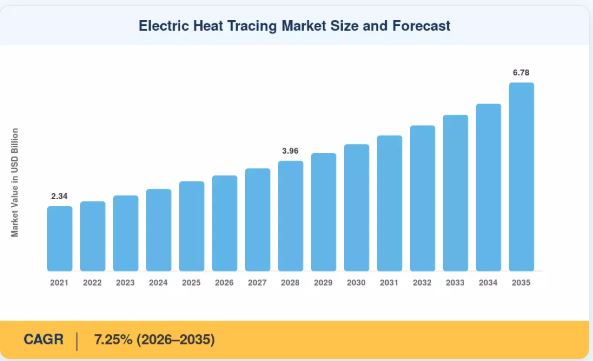
Electric Heat Tracing Market Size Expected to Grow from USD 3.44 Billion in 2025 to USD 6.78 Billion by 2035
Electric Heat Tracing Market
Electric Heat Tracing Market Size, Share and Research Report By Type (Self-Regulating, Constant Wattage, Mineral-insulated, and Skin Effect), By Component
Electric Heat Tracing Market is expanding steadily as industries adopt advanced temperature maintenance solutions for pipelines, tanks, and process equipment across energy, chemical”
NEW YORK,, NY, UNITED STATES, July 28, 2026 /EINPresswire.com/ -- The Global electric heat tracing market reached an estimated USD 3.21 billion in 2025 and is projected to grow from USD 3.44 billion in 2026 to USD 6.78 billion by 2035, registering a CAGR of 7.25% during the forecast period. Two major catalysts are accelerating this trajectory: the rapid expansion of oil & gas pipeline infrastructure across Arctic and sub-Arctic regions where freeze protection is operationally critical, and escalating regulatory mandates for process temperature maintenance in chemical, pharmaceutical, and food processing plants. With over USD 980 billion in global industrial infrastructure capital expenditure anticipated through 2035, facility operators face mounting pressure to adopt reliable, energy-efficient heat management solutions or risk costly process interruptions and safety incidents.— Market Research Future (MRFR)
Legacy steam tracing systems burdened by high water consumption, corrosion risks, and limited precision are rapidly giving way to self-regulating and constant-wattage electric heat tracing cables that integrate smart power-limiting polymer technology, zone-based temperature controllers, and remote monitoring interfaces. A recent Frost & Sullivan industry analysis estimated that top-quartile process facilities deploying advanced electric heat tracing systems alongside heat-trace management software reduced energy consumption by 20–25% and unplanned freeze-related downtime by over 35% compared to peers still operating conventional steam or fixed-resistance systems. This technology shift is not incremental it represents a structural overhaul of how global industrial operators manage thermal continuity across their piping and instrumentation networks.
Get Full PDF Sample Copy of Report: (Including Full TOC, List of Tables & Figures, Chart) @
https://www.marketresearchfuture.com/sample_request/22110
➤ How Significant Is the Electric Heat Tracing Market’s Growth?
The electric heat tracing market has demonstrated consistent and robust expansion, rising from approximately USD 2.61 billion in 2021 to an estimated USD 3.21 billion in 2025, representing a healthy historical growth trajectory. The market is expected to more than double over the next decade, driven by accelerating demand from oil & gas pipeline operators, LNG terminal developers, chemical processing plants, and commercial building operators requiring reliable freeze protection and process temperature maintenance.
Tightening safety and environmental regulations governing process temperature control in hazardous area environments, combined with the increasing complexity of industrial piping networks in extreme-climate geographies, have created acute demand for precision electric heat tracing systems. Energy companies, petrochemical producers, power utilities, and commercial real estate operators are all investing heavily in next-generation heat tracing infrastructure to reduce operational risk, lower energy overhead, and comply with increasingly stringent process safety management (PSM) standards.
➤ What Does the Future Hold for the Electric Heat Tracing Market?
Smart heat tracing and Industrial Internet of Things (IIoT) integration stand at the forefront of the market’s next growth phase. Next-generation electric heat tracing platforms are transforming thermal management from a passive, set-and-forget operation into a data-intelligent, continuously optimized process. Advanced heat-trace management systems now monitor individual circuit performance in real time, detect insulation degradation or cable faults before failures occur, and automatically adjust power output based on ambient temperature sensors and process demands.
The growing emphasis on energy efficiency and decarbonization is another defining force shaping the market’s future. Self-regulating cable technology which automatically reduces power output as pipe temperatures rise, eliminating the risk of overheating and minimizing energy waste is becoming the default specification for new installations in both hazardous and non-hazardous area applications. Parallel advances in mineral insulated (MI) cable technology are extending the operating temperature ceiling to above 650°C, unlocking new high-temperature process applications in refining, power generation, and specialty chemical manufacturing.
The LNG infrastructure boom is also driving substantial near-term demand. With over USD 380 billion in new LNG terminal and export facility investments announced globally through 2030, the requirement for cryogenic freeze protection and gas flow assurance systems is creating a significant tailwind for specialized low-temperature electric heat tracing solutions across liquefaction, storage, and regasification assets.
Direct Purchase this Research Report:
https://www.marketresearchfuture.com/checkout?currency=one_user-USD&report_id=22110
➤ Who Are the Key Players in the Electric Heat Tracing Market?
The electric heat tracing landscape is characterized by a mix of global industrial technology conglomerates, specialized cable systems manufacturers, and regional engineering solution providers. Key participants shaping the competitive dynamics include:
nVent Electric (formerly Raychem / Pentair Thermal Management) — the global market leader providing self-regulating, constant-wattage, and mineral insulated heat tracing systems across oil & gas, industrial, and commercial applications
★ Thermon Group Holdings — delivering comprehensive electric heat tracing and steam tracing solutions with deep expertise in hazardous area and flow assurance applications
★ Emerson Electric Co. — offering integrated heat tracing control and monitoring systems through its Appleton and ASCO brands, with strong coverage across the process industries
★ ABB Ltd. — providing industrial heat tracing products and digital monitoring platforms leveraging its global automation and electrification infrastructure
★ Bartec Group — specializing in explosion-proof and hazardous area heat tracing solutions for upstream oil & gas and chemical processing environments
★ Chromalox (Spirax-Sarco Engineering) — supplying high-temperature electric heat tracing cables and process heating systems for refining and specialty chemical sectors
★ Eltherm GmbH — offering a broad portfolio of self-regulating and constant-wattage cables for industrial pipeline freeze protection and process maintenance applications
★ Flexelec — providing flexible heating elements and heat tracing solutions for demanding process and building applications across Europe and global markets
★ BriskHeat Corporation — delivering flexible silicone heating solutions and heat trace systems for laboratory, industrial, and OEM thermal management applications
★ Warmup PLC — serving commercial and residential underfloor and pipe freeze protection segments with electric heat tracing and smart control systems
Competition in the market is intensifying as vendors race to embed IIoT connectivity and predictive maintenance analytics into their heat-trace management platforms, expand
hazardous area certification portfolios across global standards (ATEX, IECEx, UL), and deepen engineering and installation service capabilities for large-scale EPC-driven projects. Strategic acquisitions of regional heat tracing specialists and partnerships with process safety management consultancies are further reshaping the competitive landscape.
➤ What Are the Emerging Trends in the Electric Heat Tracing Market?
Several transformational trends are redefining how the electric heat tracing market evolves through 2035:
IIoT-Enabled Smart Heat Trace Management: Cloud-connected heat-trace management systems enabling real-time circuit monitoring, automated fault detection, and energy optimization dashboards are transitioning from premium options to standard specifications on major industrial projects.
Self-Regulating Cable Adoption: Polymer-based self-regulating cables that automatically adjust output based on ambient conditions are displacing constant-wattage systems in freeze protection applications, delivering significant energy savings and eliminating overheating risk.
High-Temperature Mineral Insulated (MI) Cable Growth: Expanding refinery turnaround and upgrader investment is driving demand for MI cables capable of sustained operation above 500°C, particularly in process heat maintenance and instrument tubing protection applications.
LNG and Hydrogen Infrastructure Demand: The global LNG buildout and emerging green hydrogen pipeline networks are creating new categories of low-temperature and cryogenic heat tracing requirements, driving product innovation in specialized cable and control systems.
Hazardous Area Certification Expansion: Operators across the Middle East, Asia-Pacific, and Latin America are specifying dual-certified (ATEX/IECEx) electric heat tracing systems, compelling vendors to broaden global certification portfolios and localize testing capabilities.
Prefabricated and Modular Heat Tracing Assemblies: To reduce on-site installation complexity and labor costs, leading suppliers are expanding prefabricated junction box assemblies, pre-terminated cable kits, and modular panel solutions that compress project schedules on large greenfield developments.
Get access to the full description of the report @
https://www.marketresearchfuture.com/reports/electric-heat-tracing-market-22110
➤ How Is the Electric Heat Tracing Market Segmented?
The electric heat tracing market report provides a comprehensive segmentation framework:
1 By Cable Type: Self-Regulating, Constant-Wattage, Mineral Insulated (MI), Series Resistance
2 By Installation Type: Freeze Protection, Process Temperature Maintenance, Roof & Gutter De-Icing, Floor Heating
3 By End-Use Industry: Oil & Gas, Chemical & Petrochemical, Power Generation, Food & Beverage, Pharmaceuticals, Commercial & Residential Buildings
4 By Component: Cables & Wires, Controls & Monitoring Systems, Accessories (Junction Boxes, End Seals, Power Connection Kits)
5 By Area Classification: Hazardous Areas (Ex-Rated), Non-Hazardous Areas
➤ What Are the Regional Insights from the Electric Heat Tracing Market?
North America commands approximately 38% of global electric heat tracing market share, underpinned by the scale of U.S. and Canadian oil sands, shale gas, and pipeline infrastructure, where freeze protection is a non-negotiable operational requirement. Stringent OSHA process safety management regulations and the National Electrical Code (NEC) compliance environment further incentivize technology adoption. The region’s mature EPC contractor ecosystem and high penetration of advanced heat-trace management software reinforce its leading position.
Europe holds the second-largest share at approximately 28%, with Norway, Russia (via export-oriented projects), Germany, and the Netherlands representing the primary markets. North Sea offshore platform maintenance, district heating network expansion, and chemical cluster investments across the Rhine-Ruhr and Rotterdam port corridors are primary demand drivers. The EU’s ATEX Directive and emerging energy efficiency mandates are compelling buyers to upgrade aging steam trace systems to modern electric alternatives.
Asia-Pacific represents a rapidly growing region, driven by LNG terminal construction across Australia, Qatar, and Southeast Asia, expanding petrochemical complex development in China and India, and the build-out of cold-chain food and pharmaceutical logistics infrastructure. Government-backed industrial park development programs across the APAC region are generating sustained demand for both freeze protection and process temperature maintenance electric heat tracing systems.
Middle East & Africa is projected to register the highest CAGR at approximately 8.6% through 2035. Saudi Aramco’s downstream diversification program, ADNOC’s refinery expansion in the UAE, and Africa’s emerging gas monetization projects in Mozambique, Tanzania, and Nigeria are creating substantial demand for hazardous-area-certified electric heat tracing systems across greenfield and brownfield developments.
South America rounds out the global picture, with Brazil’s pre-salt offshore oil fields, Colombia’s pipeline network modernization, and Chile’s mining and mineral processing industry representing the most active markets for electric heat tracing procurement and deployment across the region.
➤➤➤ Industry Analysis Reports by Market Research Future:
Indoor Farming Robots Market-
https://www.marketresearchfuture.com/reports/indoor-farming-robots-market-8616
Infrared Sensor Market-
https://www.marketresearchfuture.com/reports/infrared-sensor-market-8625
Education Pc Market-
https://www.marketresearchfuture.com/reports/education-pc-market-8660
Smartphone Sensors Market-
https://www.marketresearchfuture.com/reports/smartphone-sensors-market-8709
Industrial Radiography Market-
https://www.marketresearchfuture.com/reports/industrial-radiographys-market-10022
Vrf Systems Market-
https://www.marketresearchfuture.com/reports/vrf-system-market-10128
Carbon Dioxide Monitors Market-
https://www.marketresearchfuture.com/reports/carbon-dioxide-monitors-market-10464
Crystal Oscillators Market-
https://www.marketresearchfuture.com/reports/crystal-oscillators-market-10466
Uv Disinfection Equipment Market-
https://www.marketresearchfuture.com/reports/uv-disinfection-equipment-market-10475
Spintronics Market-
https://www.marketresearchfuture.com/reports/spintronics-market-10515
Sagar Kadam
Market Research Future
+ + +1 628-258-0071
email us here
Legal Disclaimer:
EIN Presswire provides this news content "as is" without warranty of any kind. We do not accept any responsibility or liability for the accuracy, content, images, videos, licenses, completeness, legality, or reliability of the information contained in this article. If you have any complaints or copyright issues related to this article, kindly contact the author above.
